28 September 2020

PH Agriculture – Now, “Technologies And Innovations Are The Engines Of Growth,” So Where Are We?


Going with Research, Growing with Extension

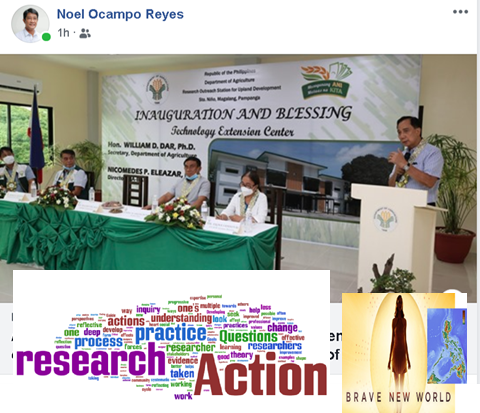
We don’t – well,, Idon’t – associate the Department of Agriculture, DA, with Research, so it is a little unsettling that I read the news item by ANN, “Agri Research Centers To Receive Funding For Enhanced Tech Development And Extension[1] (Author Not Named, 16 September 2020, DA.gov.ph). (Research-Action[2] image from WesternU.ca)

Research and Extension, R&E. So, doing its own research and extending the results to the farmers and fishers by way of technology or system, the DA is developing PH Agriculture.

So now, as far as I can see, R&E will be receiving the proper primordial attention in the countryside as Secretary of Agriculture William Dar has “directed the upgrading of the Regional Integrated Agricultural Research Centers, RIARCs, of the Department of Agriculture, DA, nationwide to launch the development of technology systems that would greatly improve Philippine agriculture,” according to ANN.

During the inauguration of the Regional Technology Extension Center in Magalang, Pampanga on 14 September, Mr Dar said:

We need to capacitate you (RIARCs) in terms of good laboratories, facilities, and equipment so that you can do your job in research and translate research outputs into something that we can massively give out to the farming and fishing communities.

Unlike in an academic setting, the R&E results that the RIARCS are getting do not go into publications but rather are meant for “(giving) out to the farming and fishing communities,” as according to Mr Dar.

Today, there are 15 RIARCS – that is, 1 each in 10 regions, 2 in Region 4 (4a & 4b), plus 1 each in CAR (located in Baguio City), CARAGA (Agusan del Sur), and ARMM (Cotabato City).

So each of the RIARCS will be receiving P50 million to upgrade its capacities and capabilities. The source of fund is the “Bayanihan to Recover as One Act” or “Bayanihan 2.” High-quality seeds, breeds of livestock and poultry, are expected to be developed among other innovations and replicated in every region to improve agriculture.

Mr Dar also said:

I’m with Senator Villar in terms of really having to reorient the system that yes, technologies and innovations are the engines of growth for modern and industrialized agriculture.

Mr Dar also said that the DA must “ensure that the programs and trainings to be implemented in the communities are technology-based or make use of technologies that improve productivity per unit area,” according to Gumamela Celes Bejarin of DA-AFID.

Here, I have personal knowledge of R&E as implemented by the RIARCS. Early this month, the RIARC of Region 1, headed by Jovita M Datuin, Manager, delivered to our Nagkaisa Multipurpose Cooperative, in my hometown of Asingan, Pangasinan, quite a number of native chickens to be raised by coop members. (See my essay, “Dream Come True – Native PH Chickens Laying 200 Eggs A Year![3]” 11 September 2020, Brave New World). Thank you Ma’am!

This is RIARCS research being extended to the village. So, the engines of growth can be as small as chicken eggs!@517


[1]https://www.da.gov.ph/agri-research-centers-to-receive-funding-for-enhanced-tech-devt-and-extension/?fbclid=IwAR0oeBWgjkftP80X7GzXpC08gttOGLERpTIBlNVf3JgmuaQrGQdj7GqNWUQtps://www.edu.uwo.ca/research/index.html

3]https://bravenewworldph.blogspot.com/2020/09/dream-come-true-native-ph-chickens.html

27 September 2020

Media Warriors In! Media Worriers Out! Speaking For PH Agriculture

Secretary of Agriculture William Dar is a warrior, intellectual. Above, note his “Ang Bagong Pananaw Sa Agrikultura.” The New Thinking For Agriculture, comprising 8 paradigms. (List below)

I am challenging PH digital media to be warriors for agriculture, not worriers of. I am taking the liberty of addressing online media directly, especially these selected Media Worriers:
(1) BusinessMirror,
(2) BusinessWorld,
(3) Manila Bulletin,
(4) Manila Times,
(5) Philippine Center for Investigative Journalism,
(6) Philippines Daily Inquirer,
(7) Philippine Star, and
(8) Rappler.

Warriors are braves; Worriers are cowards.

If they accept my media challenge, speaking for the Filipino people, for those Media Worriers to become Media Warriors, they must educate themselves on “The New Thinking for Agriculture” and its 8 paradigms:

(1)   Modernization

(2)   Industrialization

(3)   Promotion Of Exports

(4)   Consolidation Of Small- And Medium-Sized Farms

(5)   Infrastructure Development

(6)   Higher Budget & Investment

(7)   Legislative Support

(8)   Roadmap Development.

Warriors know what they are fighting for. I challenge you Media Worriers to know, understand, pronounce and promote the New Thinking For Agriculture along with its 8 paradigms.. Paradigms are “patterns” or “models” of thinking (American Heritage Dictionary). Thus, the combine harvester belongs in “Modernization” and warehousing in “Infrastructure Development.”

And now my radical proposal to create instead PH Media Warriors:

Compose a daily 2-page section on the paradigms as they gain, or regain, relevance to national agriculture.

You can design it the way you want it, but the stories must be on positive changes towards each paradigm being more fully achieved.

Once in place, the media section will serve as daily reminders what is being done to bring each paradigm truer to life:

(1)   Agriculture Modernization
The stories feature the application of new and/or improved equipment, machineries, technologies or systems that ultimate increase and sustain net returns.

(2)   Agriculture Industrialization
Farm products improved in time and with production now widespread. Such as cacao tablea and virgin coconut oil.

(3)   Agriculture Exports
Good or bad news about farm-based exports such as banana and coconuts, what government agencies are doing about them.

(4)   Agriculture Consolidation
Farmers agreeing to consolidate operations, not necessarily single ownership of the lands, resulting in economies of scale.

(5)   Agriculture Infrastructure
Infrastructure includes roads, warehouses, common service facilities and processing centers.

(6)   Agriculture Budget & Investment
A running account of national investments in agriculture in terms of budget and other expenditures.

(7)   Agriculture Legislative Support
When the Secretary of Agriculture asks for additional budget for such and such purpose, this media section should support him. Support must be continuous.

(8)   Agriculture Roadmap Development
All the while, a description of where PH Agriculture is now, in the form of a map of accomplishments, should be made available to the readers.

On Facebook share all Media Warrior articles; as PH is the social media capital of the world, you will find more Filipinos in Facebook than elsewhere.

With Media Warriors, even the most dense of Citizens, not to mention Congressmen and Senators, will begin to appreciate the importance of Agriculture and support it fully!@517

26 September 2020

Binhi Awards 2019: How Does PH Measure National Excellence In Journalism Along With National Relevance To Agriculture?


Yesterday, 25 September 2020, ANN of BusinessMirror joyfully reported, “BM’s Bumper Harvest At 2019 ‘Binhi’ Awards
[1] (Author Not Named, BusinessMirror.com.ph):

(Mirroring the past), the BusinessMirror dominated… the 2019 Philippine (Binhi Awards) by winning seven awards, including top prizes in two major categories.

The paper’s Agriculture reporter Jasper Emmanuel Y Arcalas was hailed the country’s Best Agricultural Journalist of the Year for the third consecutive year.

The BusinessMirror’s Agri-Commodities page, edited by Associate Editor Jennifer A Ng, won the Best Agriculture Page Of A Newspaperback-to-back.

The BusinessMirror Broader Look Team bagged the SL Agritech Best In Rice Reporting award for its investigative piece titled “Pre- And Post-Rice Trade Liberalization Law, Big Traders Gaming Farmer Groups.”

Easily, one can see those are matters of Significance.

Now, we look for Relevance to PH agriculture.

That is to say, they are all important and necessary in the matter of journalism for aggiedevelopment but, actually, what is the relevance of each piece of journalism to national development?

Comes in Secretary of Agriculture William Dar, whose management thoughts are contained in The New Thinking For Agriculture he came up with even before he was appointed to such position by Du30. If you ask me:

Agriculture contributing its 100% share
to national development is what Mr Dar’s
New Thinking For Agriculture is all about.

The vision of the new PH Agriculture is clear: a food-secure country and income-secure farmers and fishers.

If your journalism does not reflect that you are coming from there or going to there, your journalism may be award-winning but irrelevant!

To be relevant, your journalism must touch any combination of the 8 paradigms for the New Thinking For Agriculture as enumerated by Mr Dar:

(1)   Modernization

(2)   Industrialization

(3)   Promotion of exports

(4)   Consolidation of small- and medium-sized farms

(5)   Infrastructure development

(6)   Higher budget & investment

(7)   Legislative support

(8)   Roadmap development.

Each paradigm is a necessary area for growth contributing to a common goal: national agricultural development. You can emphasize one paradigm but not leave out the other paradigms.

Each aggie journalist must do one’s research for one’s own understanding of the news one is pursuing in relation to any of the paradigms.

There is no need for any paradigm to be mentioned specifically anytime, but the readers must be able to discern which paradigm.

Ultimately, the journalism must be for food security; above all, it must be for inclusive prosperity – no farmer left out!

Journalists must understand the New Thinking For Agriculture. Otherwise, their journalism will only be good for Binhi (seeds for planting) and notguarantee Masaganang Ani at Mataas na Kita (Bountiful Harvests & Bounteous Income).

And why hand out the 2019 awards towards the end of 2020? (image of “2019[2]” from TrophyKits.com). I think I know – the many contesting manuscripts needed to be printed out, for the reading pleasure/pressure of the judges who were mostly, if not all, not digital-fingered.

PH aggie journalism has months to catch up with the times!@517


[1]https://businessmirror.com.ph/2020/09/25/bms-bumper-harvest-at-2019-binhi-awards/
[2]https://www.trophykits.com/proddetail.asp?prod=18619-G

25 September 2020

Real, Jose Camacho Is New Chancellor Of UP Los Baños – Virtual, How About Chancellor Of Farmers’ Agriculture & Horticulture Knowledge Bank?


Today, Thursday, 24 September 2020, the UP Board of Regents, BoR, elected Jose V Camacho Jr as the new Chancellor of UP Los Baños. I was hoping to present a national program proposal for the new Chancellor to consider, somebody else, but a Chancellor is a Chancellor. The proposal I call

Farmer’s Choice
a digital knowledge base that shows
even the options users did not know existed
in terms of technologies & systems they can use.

Today, there is no such knowledge system anywhere in the world – but it has existed in my mind in the last 17 years.

It started when Director General William Dar of the International Crops Research Institute for the Semi-Arid Tropics, ICRISAT, based in India, submitted to PhilRice a common knowledge project called “Open Academy for Philippine Agriculture,” OpAPA. All digital. As a PhilRice consultant at that time, I wrote up a whole book on how to implement OpAPA: The Geography Of Knowledge, all of 198 pages. Unfortunately, nobody appreciated it. Today, OpAPA as knowledge bank exists mostly in memory. (I still have a pdf copy of it; it’s yours via email: frankahilario@gmail.com.)

“Farmer’s Choice” is actually The Geography implemented in digital language. Given the pandemic and the public  & private PH restrictions extending to September 2021, I can see the timely opportunity to build that knowledge base while everybody else is worrying about everything else.

Digital is my world now. Like photography, I am self-taught in this skill. I am a graduate of BS Agriculture major in Ag Education, UP Los Baños '65. My personal joke is that I must be a good teacher because today I have no doubt that I am the world’s #1 blogger – having published in my many blogs at least 5,000 long essays on many subjects, but mostly journalism trying to sell progressive agriculture and creative thinking.

So, I understand the science of it all. I taught myself how to blog, so, in thinking about and wanting the best way for UP Los Baños to serve the Filipino people:

Considering the pandemonium,
digital is the best way to go.
Offering Farmer’s Choice.

This calls for UP Los Baños to digitize all results of its researches since it was founded in 1908 and collect them into a library. Technical Agriculture. Available to anyone, with the caveat that the language is meant for those who understand the science behind along with the jargon.

Then translate everything in that technical library into popular language that even a high school student can understand. Popular Agriculture. Available via the cellphone anywhere. Truly this will be science serving the people.

Mr Camacho cannot tell us that UP Los Baños has zero budget for such a nationwide digital project. It has been announced that past ICRISAT Director General and present PH Secretary of Agriculture William Dar “commits publicly P100 Million for UPLB R&D[1]”. With Farmer’s Choice, OpAPA will become both virtual and real.

I’m thinking: Science with a cellphone face!@517


[1]https://www.da.gov.ph/dar-commits-p100m-for-uplb-rd/?fbclid=IwAR2ZGqlUeaFyOJhXgqP7aCVWrfS9p5-dozd31izkHQFLncmcy12qvbd2t6I

24 September 2020

High-IQ Urban Gardening – Digging Wealth Without Digging Dirt In Your Garden!


It’s the Science, whereby in a short while the soil in your garden literally turns from dirty to divine – very rich in foods for flowers, fruit trees, ornamentals, or vegetables. (Grow Rich ima
ge[1] from amazon.com)

Without digging, yes!

Cheryl Magyar gives you “6 Reasons To Stop Digging Your Garden + How To Get Started[2](01 July 2019, Rural Sprout). She says:

Now is the season to stop treating your backyard garden as a mini-farm and end the backbreaking work of digging once and for all.

Not only will your gardening “work” be more fun, you’ll end up working less hard too – which can only be a good thing.

Instead of digging up your garden, mulch it!

I have a direct experience in mulching our ricefield of 1 ha in our town of Asingan, Pangasinan, Philippines in the 1960s. I got the idea from American Edward H Faulkner: minimum tillage. I told the giant Howard rotavator tractor operator not to set the rotating blades to any depth but to simply pass the big, hulky thing over the field. My brother-in-law Inso said later he saw the operator smiling on the side. Why because he knew that would hardly use up any diesel fuel. But I also knew that the counter-pointed rotating blades will cut finely the weeds & soil in the same motion & mix them well on the upper surface of the soil, spread across the field as it went. My mulch!

Many years later, Inso told me he had continued that kind of mulching with his hand tractor and the results are as amazing – greater harvests. His neighbor farmers told him they had been imitating everything they saw him doing, but their yields were still much lower. He never told them about the mulching.

If you dig your garden, you are destroying the soil structure. Miss Cheryl says:

Fluffing the soil, then recompacting it, either by tractor or feet, destroys the intricate soil structure. It also prevents air and water penetration to the roots of the plants. Water is essential to the life of the plant; don’t cut off the supply, rather increase it by building the soil over time.

If your garden is covered green, meaning you don’t dig it, Miss Cheryl says, “The lack of bare soil prevents… seeds of annuals from germinating.” No weeds!

When you stop digging, over time your garden becomes more fertile. This will also encourage the multiplication of earthworms, which help aerate the soil, not to mention contribute their waste as soil wealth.

With your surface mulch, you will not have to water your crop every day, if at all.

And yes, you will experience higher yields in your Do-Not-Disturb Vegetable Garden as you add compost and organic matter to it.

There is another benefit if you do not disturb your garden. Miss Cheryl says:

Where you leave the soil unturned, beneficial organisms can thrive in their natural undisturbed environment. This allows for a balance between prey and predator species.

This is Gardening Without Pests!@517


[1]https://www.amazon.com/Think-and-Grow-Rich-Legacy-audiobook/dp/B07D8LKF22

[2]https://www.ruralsprout.com/no-dig-garden/?fbclid=IwAR1ps6INVg0-7HD2ReQ8zO94JD79mE8WasBbbPmpAtqW5Fdx5oDqSFsgOD8

23 September 2020

“PH Export Bananas Being Attacked By Coronavirus!”


In case you didn’t know (I didn’t): “Banana is one of the Philippines’ major export fruit crops, producing more than 2 million metric tons (MT) every 3 months (19 June 2019[1],” Press Reader). That major.

Above, read my scary title again – might as well be physically true as sounded by local banana exporters 3 months ago and in the words of Secretary of Agriculture William Dar: “We’re losing our market share to other countries.” He is referring to Cavendish banana being exported by other countries. That is according to the report of Madelaine B Miraflor (22 September 2020, “DA Worries PH Losing Export Market Share In Bananas[2],Manila Bulletin). Miss Madeleine says it is something Mr Dar is “starting to seriously worry about.” Mr Dar says (Mr Dar’s image[3] from Manila Bulletin):

The Philippines is losing in the (banana) export war. What happened? ¶ “If left unchecked, this will substantially reduce the Philippines’ exports, disrupt trade in the international markets, and cause suffering on (our) banana growers, farmers, workers and their families, which may lead to social unrest.

Mr Dar’s Big Worry derives from the statement of the Pilipino Banana Growers and Exporters Association, PBGEA President Victor S Mercado Jr that he made 3 months ago about a likely loss of demand (banana box image above[4] from Avante Agri-Products):

There is a risk China, the current biggest export market for Philippine’s Cavendish banana, may prefer to source its supply of the yellow fruit from Vietnam and Cambodia in the next months because these countries have fewer COVID-19 cases.

Covid-19 is not the Philippines’ fault, but it’s there bothering all countries.

From another angle, Miss Madeleine says:

(PBGEA Chair Alberto Bacani) thinks the country’s banana output will likewise decline this year due to loss in hectarage in banana plantation, thanks to the Panama disease, as well as stiff market competition overseas.

There are now 2 major diseases that our banana growers have to worry about: transmission of the human Covid-19 virus through the transactions, as well as transmission of fungal wilt (Panama disease).

Big problem requires bold moves.

So, Mr Dar has:

Assigned P100 million to rehabilitate Panama-disease affected Cavendish plantations in Mindanao, both big and small growers; and, in so doing:

Challenged the PBGEA to match that P100 million for the conduct of a sustainable research and development (R&D) program to control the disease and rehabilitate affected areas.

The R&D program will produce by tissue culture plantlets of the Panama disease-resistant banana varieties to be distributed to farmers to rehabilitate their farms.

Additionally, outside the Cavendish farms, for other farmers in other places, Mr Dar says the DA will implement a nationwide development program for the cooking banana or saba, of the Cardaba variety. The fund of P120 million will cover 10 provinces: Apayao, Cagayan, Oriental Mindoro and Quezon in Luzon; Samar and Leyte in the Visayas; and Agusan Del Norte, Davao Del Sur, Lanao Del Norte and North Cotabato in Mindanao.

Under Mr Dar, the DA has got all the banana bases covered!@517


[1]https://www.pressreader.com/philippines/tempo-9gc1/20190619/281921659568298
[2]https://mb.com.ph/2020/09/22/da-worries-ph-losing-export-market-share-in-bananas/?
bclid=IwAR3MHIGQkkexEvbVHgWU3GAIezYttcXA9TWDMW7_qAljajRoq24OBLhgxTk
[3]https://mb.com.ph/2020/09/22/da-worries-ph-losing-export-market-share-in-bananas/
[4]https://www.avanteagri.com/products-packaging/

22 September 2020

Milking The Coconut Industry In The Philippines


More than 5 years ago, in February of 2015, former UP System President Emil Q Javier came up with a position paper published by the National Academy of Science and Technology titled “Modernization Of The Coconut Industry” (NAST Bull 8, 5 pages in pdf). In Bull 8, Mr Javier showed that we had scarcely milked the coconut dry of its numerous food, medicine and other benefits. (coco fruits image[1] from The Kahimyang Project, glasses of milk[2] from Stanpac)

Here comes the news from the Department of Agriculture, DA, under Secretary of Agriculture William Dar, “DA Moves To Integrate Coconut, Dairy Farming[3] (Louise Maureen Simeon, 20 September 2020, PhilStar Global). The Memorandum of Agreement, MoA, has been signed for the Coconut-Carabao Development Project, CCDP. The CCDP is primarily aimed to raise the income of coco farmers to desirable levels. It is a 2-year project covering 17 sites nationwide.

The CCDP is a collaboration of the Philippine Carabao Center, PCC, and the Philippine Coconut Authority, PCA, both agencies under the DA. The CCDP will be working with local government units, LGUs, municipal and/or provincial, “for the provision of technical support services, monitoring, and allotment of space for marketing facilities.”

So, the coconut fields will be giving out another form of commercial liquid: carabao’s milk. As a consumer myself, that is a much welcome news. In my hometown Asingan, Pangasinan, we have had a herd of Indian buffalos being raised by a cooperative for their milk – and I can assure you that the milk is delicious!

 “The milk produced out of the CCDP is seen to contribute to the supply of milk required… for the national feeding program for undernourished Filipino children.”

According to Mr Javier, there are about 3 million farmers primarily engaged in coconut “cultivation” – which in reality is mostly watching over the area where the coconut trees are growing. He says the Philippines is “the world’s largest coconut producer and coconut oil exporter.”

Mr Javier asks:

We are the global leader in coconut production. How do we keep that dominant position and at the same time generate greater value out of that comparative advantage? In other words, how do we modernize the Philippine coconut industry to make it more productive, globally competitive but environmentally sustainable and equitable, particularly to the small farmers who can be and are often short-changed in the rush toward agriculture modernization?

Since we have giant headaches with coconut farming and farmers, why not switch to oil palm and rubber instead?

Mr Javier says:

(1)   Coconut is typhoon-resilient and salt-tolerant. The tree can be uprooted and/or broken only by extremely strong winds.

(2)   Coconut has a diversity of uses that oil palm and rubber cannot match.

(3)   With sunlight filtering among the trees, we can intercrop with both annuals and perennials, thus creating more employment, more food – and more cash for the coco farmers.

More crops, more produce, more income. Yes Sir, our coco farmers have for too long remained poor!

Milk out of those tall trees? That would be using our coconuts!@517


[1]https://kahimyang.com/kauswagan/articles/2451/today-in-philippine-history-june-30-1973-philippine-coconut-authority-was-established-by-virtue-of-pd-no-232
[2]https://www.stanpacnet.com/glass-packaging-benefits/
[3]https://www.philstar.com/business/2020/09/20/2043667/da-moves-integrate-coconut-dairy-farming

Watching Germanwatch watching Climate Change within countries of the world – unfortunately, it’s watching Effects , not Causes . Not how ...