02 October 2020

Science Going Digital For PH Farmers At UP Los Baños? My Dream Lives On With PhilEASNet!


Extension in Digital Form.

Less than 2 weeks ago, I wrote about my dream of a digital agriculture for my country involving UP Los Baños (19 September 2020, PH, Even Beyond The Du30 Terrestrial Lockdown To Sept 2021, UP Los Baños Needs Intellectual Release From The Silence Of Science!” Brave New World PH).

Yesterday afternoon, Wednesday, came the webinar with the theme “Recalibrating Extension And Advisory Services For The New Normal” sponsored by the Philippine Extension & Advisory Services Network, PhilEASNet. Surprise! The digital handout said:

Dealing with this (coronavirus) health crisis… must be balanced with the important task of  EAS (extension and advisory services) – that is to provide farmers or farming communities with the right information, knowledge, skills, and technologies to efficiently produce food for the populace.

EAS takes care of the spread of information, knowledge, skills and technologies, yes – that takes care of Content. How do you take care of Form? That’s what I have been thinking of: Digital.

Everything must now be digital!
Digital Content in Digital Form = Digital Agriculture, the other DA.

Digital Content:
With that webinar, I can see that PhilEASNet already has the digital content and the digital extension of it mapped out. But not the form.

Digital Form:
The form I have in mind, since 17 years ago, is digital – in 2 languages: technical and popular. In response to now-Secretary of Agriculture William Dar when he was still Director General of the International Crops Research Institute for the Semi-Arid Tropics, ICRISAT, to his proposal Open Academy for Philippine Agriculture, OpAPA, in 2003 as an extension consultant at PhilRice, I wrote out a book on how to give flesh to OpAPA – I called it The Geography Of Knowledge, GK(GK is still intact; you can have a free pdf copy if you email me, frankahilario@gmail.com).

So you have a knowledge bank, a GK, and here is one entry in transplanting rice:

straight line – Ilocano, nalinteg a linya (with the explanation of why it should be straight). The language of the user is 50% of the GK.

Which is my expansion of this position of PhilEASNet, as the 3rd aim of the webinar was this:

Provide principles in rebranding and recalibrating extension strategies and services, especially using the digital platform, to cope with the new normal/reality. (image of digital men[1] from LYFE)

“Especially using the digital platform” – that was music to my ears!

Adding to my pleasure was that the current headquarters of PhilEASNet is at the College of Public Affairs and Development, UPLB, my alma mater.

Says PhilEASNet of itself:

PhilEASNet is a national organization of extension professionals and practitioners who serve as partner advocates in creating avenues for continuing development of a cadre of morally responsible, competent, dedicated and self-directed experts in pursuit of advancing the theory and practice of extension.

New, Digital Agriculture, the other DA, means:
Extension cadres spreading Knowledge – that’s EAS;
Knowledge in digital form in the user’s language – that’s GK.
Isn’t that a Match Made in Extension Heaven!@
517


[1]https://www.lyfemarketing.com/blog/digital-marketing-vs-traditional-marketing/

01 October 2020

Food Loss & Waste – Now Is The Time For All Food Men To Come To The Aid Of Their Country!


On 19 December 2019, the United Nations designated 29 September as the “International Day of Awareness of Food Loss and Waste.”Subsequently, on 29 September 2020, UP Los Baños via the Postharvest Horticulture Training & Research Center, PHTRC, under Director Dormi Del Carmen, held via Zoom the webinar “Food Loss and Waste Reduction Amidst the COVID-19 Pandemic.” (above bottom image) broadcast hosted by Information Technology Center of UPLB, here is the rationale of the webinar:

It is of paramount importance to reduce food loss and waste in order to reduce hunger and poverty and mitigate the effects of climate change.

Speakers at the webinar were, all ladies from UPLB: Elda B Esguerra, Professor of the Institute of Crop Science, and former PHTRC Director; Edralina P Serrano, also former PHTRC Director; and Lotis E Mopera, former Director, Institute of Food Science & Technology. Arnel A Apaga, Director of the Research Division of PhilMech, joined them.

Topmost image: ANN says that with their tomatoes rejected by traders, farmers of the town of Kalayaan in Laguna dumped their produce by the roadside (Author Not Named, 09 October 2018, “After Being Rejected, Farmers Forced To Throw Away Tons Of Surplus Tomatoes[1],” Coconuts Manila) Total food thrown? An estimated 10 tons worth P4 Million (US$80,000)!

Last year, “tons of produce dumped by the side of the road by frustrated farmers” in Luzon (05 June 2019, Frank A Hilario, “All Those Mangoes Should Have Been Sold Before They Were Even Produced!” THiNK Journalism). This year, another dumping of tons of tomatoes in the mountains of Luzon has been reported (04 July 2020, Frank A Hilario, “Why In PH Agriculture, Science Is Not Helping Journalism, & Journalism Is Not Helping Farming,” THiNK Journalism).

Actually, we know enough science to prevent food loss and food waste – except that application of such knowledge is the problem!

I say now:

The practice of Agriculture must continue to Food!
(That is why we have the UN Food and Agriculture Organization.)

To reduce food loss and waste, farm produce must undergo food processing. Miss Lotis says that “processing” means transforming raw materials or ingredients by physical or chemical methods. The process includes combining raw food ingredients to produce marketable food products. The steps include drying, freezing and canning.

I am reading and rereading from the UN the document “#FLWDay” that commemorates the International “Food Loss and Waste Awareness Day” – and I get the idea that:

We are un-intelligent when we separate food production from food loss and food waste!

I say it is the duty of farmers to produce food for a village. Corollary: It is the duty of villagers to serve and conserve food for everyone!

The just-concluded UP Los Baños postharvest webinar has reminded us that we have separated food from consumption. Because of that arbitrary separation, we have not seen how necessary it is to conserve food.

All that makes the Postharvest Scientists The New Guardians of the Universe in the Matter of Food!@517


[1]https://coconuts.co/manila/news/rejected-farmers-forced-throw-away-tons-surplus-tomatoes/

30 September 2020

Where Did Those P40 Million Worth Of Catsup Go! Ketchup To Catch Up With Tomato Farmers In The Ilocos – William Dar


Today, how come the Northern Foods Corporation, NFC, based in Sarrat, Ilocos Norte, owes tomato farmers of the Ilocos almost P40 Million? A clue is that the NFC is a government corporation
[1] (NFC.gov.ph), and government is not very good in business, is it? Even if the product is as popular in Filipino homes as catsup or ketchup. (ketchup bottles[2] from NDTV Food)

With its huge farmer debt, the NFC has been hardly operating. Here comes the Department of Agriculture, DA, under Secretary of Agriculture William Dar, who now is, according to an official DA news release, “(allotting) P65 million to help (the NFC) get back on its feet.” During a visit to the NFC processing facility in Sarrat, Ilocos Norte on 26 September 2020 (image above), Mr Dar said:

We will extend needed financial assistance to the (NFC) to make it financially afloat and thus make it attractive for potential investors enroute to its privatization.

The total P65 Million consists of P26 Million from the Agricultural Competitiveness Enhancement Fund, ACEF, to help finance NFC operations; and P39 Million from the Agricultural Credit Policy Council, ACPC, so NFC can pay its arrears to farmers.

Mr Dar said, “We were informed that the company has an inventory of P120-M worth of tomato paste, which they can use to pay out the (ACEF and ACPC loans).”

Tomato is a high-value cash crop in the Ilocos Region, with a production area of 800 ha. The production system seems ideal. The NFC sources fresh ripe tomatoes, particularly the variety “Ilocos Red,” from 3,000 farmers in Ilocos Norte and Ilocos Sur. The NFC not only provides technical assistance but also arranges financing with fertilizers, pesticides and other inputs, including harvest containers. Farmers grow tomato from October to December, planting after the main rice crop. Harvest begins in January.

The NFC has a processing capacity of 500 metric tons of tomatoes every day, producing some 4,000 MT of tomato paste every processing season, from January to April.

In the Philippines, we have the brands Del Monte, Heinz, NutriAsia, UFC. Actually, those may be partially or wholly made from NFC tomato paste, differently processed and prepared by those ketchup companies. The NFC also supplies tomato paste to food chains, fish canners, and tomato sauce manufacturers. Its supply comprises 13% of the Philippines’ 30,000 MT yearly consumption.

Among private interests wanting to invest in the NFC is a group led by former Candaba, Pampanga Mayor Jerry Pelayo. Mr Pelayo says he will meet again with the NFC management to discuss details, including rehabilitation and upgrading of the processing facilities.

Pelayo’s group is also planning upgrading the NFC so it can process other raw materials such as mango and pineapple. This will ensure that the plant is productive not only for 4 months but occupied and productive throughout the year. In a way, farmers’ incomes can then be sustainable.

Sustainability is for the NFC – and the farmers.
You can’t have one without the other!@
517


[1]http://nfc.gov.ph/history/
[2]https://food.ndtv.com/reviews/cremica-heinz-del-monte-and-other-favourites-which-ketchup-tastes-the-best-777783

29 September 2020

A Revolution Of Our Times! Landownership Out, Bandownership In


Here is another Brave New World PH!

54 days ago from today, 28 September 2020, The Editorial of The Manila Times predicted a modern revolution in PH Agriculture brought about not by a presidential decree but by a department head’s Administrative Order, AO, saying[1]:

The Department of Agriculture has set into motion a program of consolidation and clustering in the nation’s farm and fisheries sector that will, if it is allowed to be carried out as designed, completely transform Philippine agriculture from a perennial laggard to one of the country’s economic strengths.

“That will… completely transform Philippine agriculture” from being a laggard to being a source of power.

The Times’ editorial is in fact boldly titled, “DA Consolidation Program Will Save PH Agriculture” – and let us thank God it is worth saving!

(The DA head) signed… AO 27 on 05 August 2020, auspiciously marking his first year of service as the country’s agriculture chief. He said that many countries have long adopted farm and fishery clustering to increase food production levels, improve farmers’ and fishers’ incomes, and provide better access to resources, technologies, and markets for farmers and fisherfolk.

The AO calls for a “Farm and Fisheries Clustering and Consolidation (F2C2) Program.” DA Chief/Secretary of Agriculture William Dar says the F2C2 is “the first formal, comprehensive, and holistic government initiative to be implemented at the national level.” (management image[2] from Quora)

In baseball parlance, “holistic” means it covers all the bases. If you ask me, F2C2 is comprehensivewhere the  Agricultural Land Reform Code, RA 3844, signed by President Diosdado Macapagal in 1963, is fragmentary. RA 3844 is more about landownership and has nothing about managing the land to make it more productive so that the farmer can be more prosperous.

Not landownership, F2C2 is more about what I call bandownership, that is, where as in a musical band, everything plays out for the music that is good for all. Common ownership – i.e., formally or informally, the land is ours. Landownership, which the activist pro-farmer groups insist must prevail, has shown success in ownership but failure in management.

The farm operations must be shown to be productive and profitable – and for the farmer and his family a resulting life of prosperity.

Mr Dar said:

The F2C2 program is needed to enable the agriculture and fishery (sectors) to attain economies of scale, and thus achieve cost-efficient production, (harvesting), processing and marketing operations, subsequently increasing farmers’ and fishers’ incomes.

Economies of scalemeans even as the volume of production increases, the unit cost decreases. Impossible under landownership.

Additionally, Mr Dar says, “We will count on the strong support of farmers’ groups and local government units to successfully undertake our joint F2C2 program.” He notes that “the first major challenge is consolidating the country’s fragmented small farm holdings.”

On my part, I note that the first major challenge is to educate the farmers on both entrepreneurship and bandownership.

Until farmers accept that their prosperity lies in farm management and not in land ownership, Agriculture will keep them Poor!@517


[1]https://www.manilatimes.net/2020/08/20/opinion/editorial/da-consolidation-program-will-save-ph-agriculture/757748/
[2]https://www.quora.com/What-are-some-of-the-different-management-styles

28 September 2020

PH Agriculture – Now, “Technologies And Innovations Are The Engines Of Growth,” So Where Are We?


Going with Research, Growing with Extension

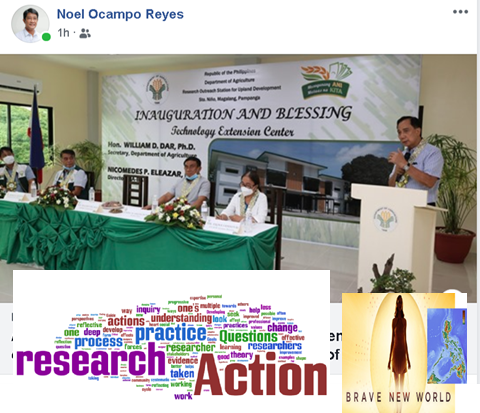
We don’t – well,, Idon’t – associate the Department of Agriculture, DA, with Research, so it is a little unsettling that I read the news item by ANN, “Agri Research Centers To Receive Funding For Enhanced Tech Development And Extension[1] (Author Not Named, 16 September 2020, DA.gov.ph). (Research-Action[2] image from WesternU.ca)

Research and Extension, R&E. So, doing its own research and extending the results to the farmers and fishers by way of technology or system, the DA is developing PH Agriculture.

So now, as far as I can see, R&E will be receiving the proper primordial attention in the countryside as Secretary of Agriculture William Dar has “directed the upgrading of the Regional Integrated Agricultural Research Centers, RIARCs, of the Department of Agriculture, DA, nationwide to launch the development of technology systems that would greatly improve Philippine agriculture,” according to ANN.

During the inauguration of the Regional Technology Extension Center in Magalang, Pampanga on 14 September, Mr Dar said:

We need to capacitate you (RIARCs) in terms of good laboratories, facilities, and equipment so that you can do your job in research and translate research outputs into something that we can massively give out to the farming and fishing communities.

Unlike in an academic setting, the R&E results that the RIARCS are getting do not go into publications but rather are meant for “(giving) out to the farming and fishing communities,” as according to Mr Dar.

Today, there are 15 RIARCS – that is, 1 each in 10 regions, 2 in Region 4 (4a & 4b), plus 1 each in CAR (located in Baguio City), CARAGA (Agusan del Sur), and ARMM (Cotabato City).

So each of the RIARCS will be receiving P50 million to upgrade its capacities and capabilities. The source of fund is the “Bayanihan to Recover as One Act” or “Bayanihan 2.” High-quality seeds, breeds of livestock and poultry, are expected to be developed among other innovations and replicated in every region to improve agriculture.

Mr Dar also said:

I’m with Senator Villar in terms of really having to reorient the system that yes, technologies and innovations are the engines of growth for modern and industrialized agriculture.

Mr Dar also said that the DA must “ensure that the programs and trainings to be implemented in the communities are technology-based or make use of technologies that improve productivity per unit area,” according to Gumamela Celes Bejarin of DA-AFID.

Here, I have personal knowledge of R&E as implemented by the RIARCS. Early this month, the RIARC of Region 1, headed by Jovita M Datuin, Manager, delivered to our Nagkaisa Multipurpose Cooperative, in my hometown of Asingan, Pangasinan, quite a number of native chickens to be raised by coop members. (See my essay, “Dream Come True – Native PH Chickens Laying 200 Eggs A Year![3]” 11 September 2020, Brave New World). Thank you Ma’am!

This is RIARCS research being extended to the village. So, the engines of growth can be as small as chicken eggs!@517


[1]https://www.da.gov.ph/agri-research-centers-to-receive-funding-for-enhanced-tech-devt-and-extension/?fbclid=IwAR0oeBWgjkftP80X7GzXpC08gttOGLERpTIBlNVf3JgmuaQrGQdj7GqNWUQtps://www.edu.uwo.ca/research/index.html

3]https://bravenewworldph.blogspot.com/2020/09/dream-come-true-native-ph-chickens.html

27 September 2020

Media Warriors In! Media Worriers Out! Speaking For PH Agriculture

Secretary of Agriculture William Dar is a warrior, intellectual. Above, note his “Ang Bagong Pananaw Sa Agrikultura.” The New Thinking For Agriculture, comprising 8 paradigms. (List below)

I am challenging PH digital media to be warriors for agriculture, not worriers of. I am taking the liberty of addressing online media directly, especially these selected Media Worriers:
(1) BusinessMirror,
(2) BusinessWorld,
(3) Manila Bulletin,
(4) Manila Times,
(5) Philippine Center for Investigative Journalism,
(6) Philippines Daily Inquirer,
(7) Philippine Star, and
(8) Rappler.

Warriors are braves; Worriers are cowards.

If they accept my media challenge, speaking for the Filipino people, for those Media Worriers to become Media Warriors, they must educate themselves on “The New Thinking for Agriculture” and its 8 paradigms:

(1)   Modernization

(2)   Industrialization

(3)   Promotion Of Exports

(4)   Consolidation Of Small- And Medium-Sized Farms

(5)   Infrastructure Development

(6)   Higher Budget & Investment

(7)   Legislative Support

(8)   Roadmap Development.

Warriors know what they are fighting for. I challenge you Media Worriers to know, understand, pronounce and promote the New Thinking For Agriculture along with its 8 paradigms.. Paradigms are “patterns” or “models” of thinking (American Heritage Dictionary). Thus, the combine harvester belongs in “Modernization” and warehousing in “Infrastructure Development.”

And now my radical proposal to create instead PH Media Warriors:

Compose a daily 2-page section on the paradigms as they gain, or regain, relevance to national agriculture.

You can design it the way you want it, but the stories must be on positive changes towards each paradigm being more fully achieved.

Once in place, the media section will serve as daily reminders what is being done to bring each paradigm truer to life:

(1)   Agriculture Modernization
The stories feature the application of new and/or improved equipment, machineries, technologies or systems that ultimate increase and sustain net returns.

(2)   Agriculture Industrialization
Farm products improved in time and with production now widespread. Such as cacao tablea and virgin coconut oil.

(3)   Agriculture Exports
Good or bad news about farm-based exports such as banana and coconuts, what government agencies are doing about them.

(4)   Agriculture Consolidation
Farmers agreeing to consolidate operations, not necessarily single ownership of the lands, resulting in economies of scale.

(5)   Agriculture Infrastructure
Infrastructure includes roads, warehouses, common service facilities and processing centers.

(6)   Agriculture Budget & Investment
A running account of national investments in agriculture in terms of budget and other expenditures.

(7)   Agriculture Legislative Support
When the Secretary of Agriculture asks for additional budget for such and such purpose, this media section should support him. Support must be continuous.

(8)   Agriculture Roadmap Development
All the while, a description of where PH Agriculture is now, in the form of a map of accomplishments, should be made available to the readers.

On Facebook share all Media Warrior articles; as PH is the social media capital of the world, you will find more Filipinos in Facebook than elsewhere.

With Media Warriors, even the most dense of Citizens, not to mention Congressmen and Senators, will begin to appreciate the importance of Agriculture and support it fully!@517

26 September 2020

Binhi Awards 2019: How Does PH Measure National Excellence In Journalism Along With National Relevance To Agriculture?


Yesterday, 25 September 2020, ANN of BusinessMirror joyfully reported, “BM’s Bumper Harvest At 2019 ‘Binhi’ Awards
[1] (Author Not Named, BusinessMirror.com.ph):

(Mirroring the past), the BusinessMirror dominated… the 2019 Philippine (Binhi Awards) by winning seven awards, including top prizes in two major categories.

The paper’s Agriculture reporter Jasper Emmanuel Y Arcalas was hailed the country’s Best Agricultural Journalist of the Year for the third consecutive year.

The BusinessMirror’s Agri-Commodities page, edited by Associate Editor Jennifer A Ng, won the Best Agriculture Page Of A Newspaperback-to-back.

The BusinessMirror Broader Look Team bagged the SL Agritech Best In Rice Reporting award for its investigative piece titled “Pre- And Post-Rice Trade Liberalization Law, Big Traders Gaming Farmer Groups.”

Easily, one can see those are matters of Significance.

Now, we look for Relevance to PH agriculture.

That is to say, they are all important and necessary in the matter of journalism for aggiedevelopment but, actually, what is the relevance of each piece of journalism to national development?

Comes in Secretary of Agriculture William Dar, whose management thoughts are contained in The New Thinking For Agriculture he came up with even before he was appointed to such position by Du30. If you ask me:

Agriculture contributing its 100% share
to national development is what Mr Dar’s
New Thinking For Agriculture is all about.

The vision of the new PH Agriculture is clear: a food-secure country and income-secure farmers and fishers.

If your journalism does not reflect that you are coming from there or going to there, your journalism may be award-winning but irrelevant!

To be relevant, your journalism must touch any combination of the 8 paradigms for the New Thinking For Agriculture as enumerated by Mr Dar:

(1)   Modernization

(2)   Industrialization

(3)   Promotion of exports

(4)   Consolidation of small- and medium-sized farms

(5)   Infrastructure development

(6)   Higher budget & investment

(7)   Legislative support

(8)   Roadmap development.

Each paradigm is a necessary area for growth contributing to a common goal: national agricultural development. You can emphasize one paradigm but not leave out the other paradigms.

Each aggie journalist must do one’s research for one’s own understanding of the news one is pursuing in relation to any of the paradigms.

There is no need for any paradigm to be mentioned specifically anytime, but the readers must be able to discern which paradigm.

Ultimately, the journalism must be for food security; above all, it must be for inclusive prosperity – no farmer left out!

Journalists must understand the New Thinking For Agriculture. Otherwise, their journalism will only be good for Binhi (seeds for planting) and notguarantee Masaganang Ani at Mataas na Kita (Bountiful Harvests & Bounteous Income).

And why hand out the 2019 awards towards the end of 2020? (image of “2019[2]” from TrophyKits.com). I think I know – the many contesting manuscripts needed to be printed out, for the reading pleasure/pressure of the judges who were mostly, if not all, not digital-fingered.

PH aggie journalism has months to catch up with the times!@517


[1]https://businessmirror.com.ph/2020/09/25/bms-bumper-harvest-at-2019-binhi-awards/
[2]https://www.trophykits.com/proddetail.asp?prod=18619-G

Watching Germanwatch watching Climate Change within countries of the world – unfortunately, it’s watching Effects , not Causes . Not how ...